




Insomnia - Faithless
The Club Anthem That Never Sleeps
When British electronic group Faithless released Insomnia in 1995, few could have predicted it would become one of the most iconic dance records of all time.
Driven by a thunderous bassline, hypnotic build-up and the unmistakable spoken-word vocal of Maxi Jazz, Insomnia didn’t just fill dancefloors it defined an era of electronic music.
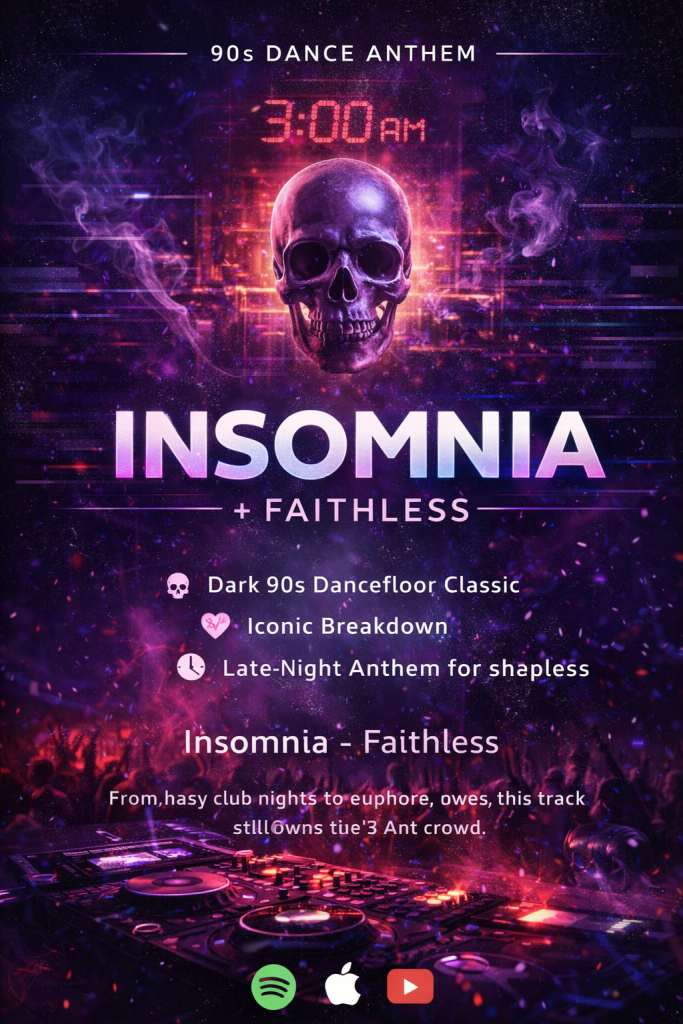
“I Can’t Get No Sleep” – A Lyric That Became Legendary
Unlike many dance tracks of the 90s, Insomnia wasn’t built around a sung chorus. Instead, it featured a rhythmic spoken monologue:
“I can’t get no sleep…”
Delivered with intensity and urgency, the vocal felt raw, personal and almost philosophical a reflection of restless energy, anxiety and inner tension.
That emotional authenticity helped the track stand out in a crowded rave scene.
The Production That Changed Dance Floors
Produced by Rollo Armstrong and Sister Bliss, Insomnia blended:
- Rolling trance-style arpeggios
- Deep, driving bassline
- Massive orchestral-style stabs
- Slow-building tension
- Explosive drop
The structure was revolutionary at the time. Long builds created anticipation before unleashing one of the most powerful drops in 90s dance music.
The 8-minute club mix became a staple in superclubs across Europe and beyond.
The track’s reach was global, spanning clubs, radio airplay and chart success across Europe and beyond — all without a single sung lyric.
Global Chart Impact
Insomnia achieved huge international success:
- 🇬🇧 UK – Peaked at No. 3
- 🇩🇪 Germany – No. 1
- 🇳🇱 Netherlands – No. 1
- 🇫🇮 Finland – No. 1
- 🇦🇺 Australia – Top 5
It became one of the biggest dance singles of the mid-1990s and later re-entered charts with remixes in the 2000s, proving its longevity.
Few dance tracks from that era remain as instantly recognisable today.
Cultural Legacy
Insomnia transcended club culture.
It became:
- A festival anthem
- A radio crossover hit
- A staple in Ibiza and global DJ sets
- A defining sound of late-90s electronic music
The track influenced countless trance, progressive and techno producers who saw how tension, atmosphere and spoken word could create something cinematic and unforgettable.
Even decades later, when that bassline rolls in, crowds react instantly.
A Modern Echo – Sunset (2026)
Just as Insomnia captured the restless energy of the 1990s rave movement, modern melodic electronic tracks are carrying forward that sense of emotional build and atmosphere.
Released in February 2026, Sunset channels:
- Gradual, cinematic build-ups
- Emotional melodic progression
- Immersive, late-night atmosphere
- Festival-ready dynamics
Where Insomnia delivered tension and release in dark club spaces, Sunset brings a warmer, golden-hour energy — but with the same focus on emotional connection and powerful musical progression.
Since its release, Sunset has been steadily gaining traction, finding support among DJs who favour melodic, progressive and trance-influenced sets. Its growth reflects a timeless truth first proven by Faithless:
Dance music is most powerful when it builds emotion before it drops energy.
Sunset
Other Emotional Piano Motif Music
For an Angel – Paul van Dyk
A soaring, melodic trance anthem with that same emotional uplift. The melody carries the entire track just like Children.
Greece 2000 – Three Drives
Dreamy, hypnotic, sun-drenched trance. Very melodic and atmospheric — perfect sunset vibes.
9 PM (Till I Come) – ATB
More guitar-led than piano, but emotionally similar and built around a repeating melodic hook.
Saltwater – Chicane
Oceanic, Balearic and emotional. It has vocals, but the melodic trance backbone feels very much in the same emotional world.
Adagio for Strings – Tiësto
More intense and dramatic, but emotionally powerful and instrumental-led.
Xpander – Sasha
Deep, progressive and atmospheric. Less piano, more evolving layers but equally hypnotic.
Café del Mar – Energy 52
Arguably one of the closest in terms of timeless melodic trance energy.